I Think I Accidentally Built a Full-Stack Framework?
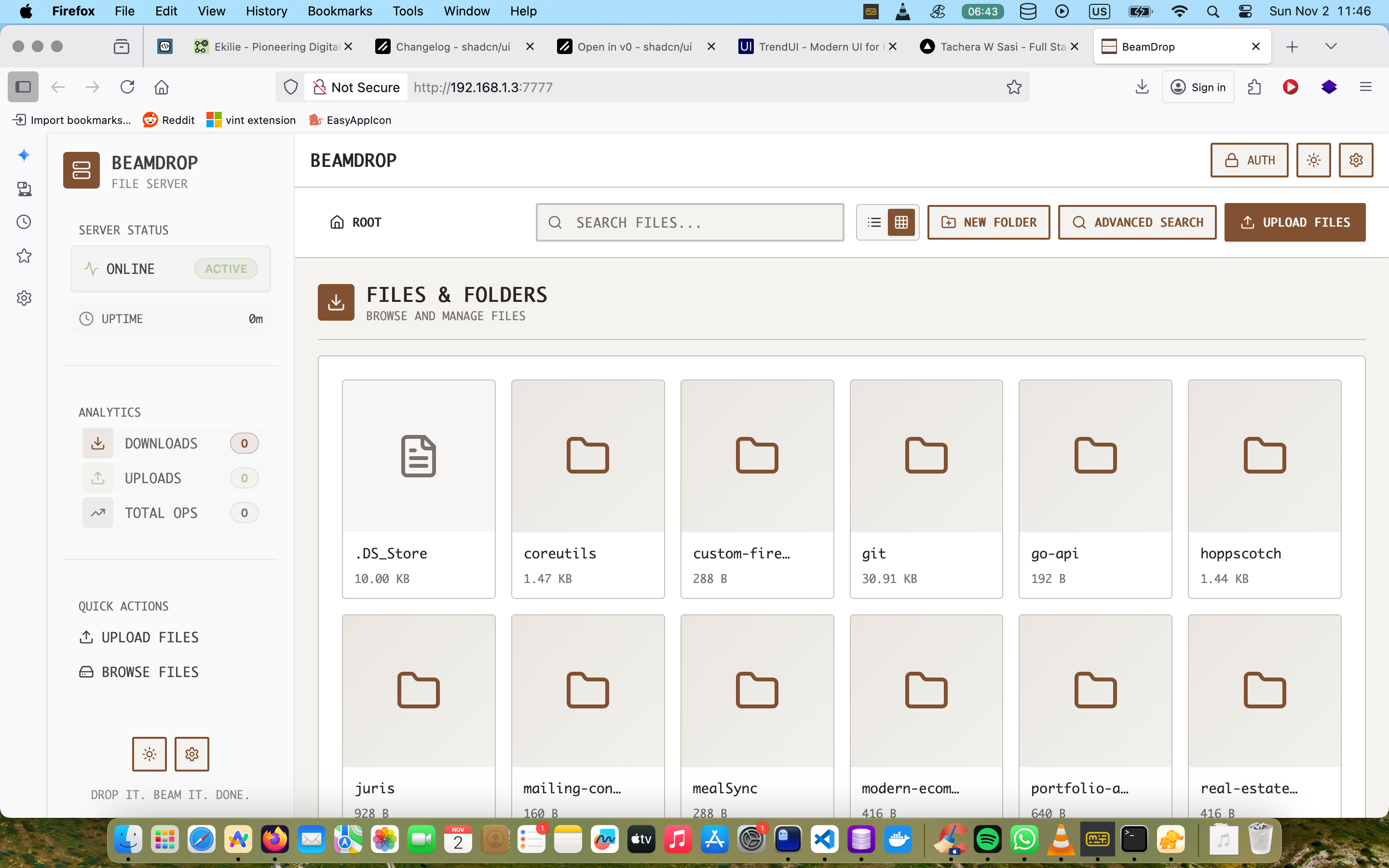
Table of Contents
Look, I just wanted to share some files.
The Innocent Beginning
It started, as these things always do, with a simple problem: I needed to share files between my devices. “I’ll just write a quick Go server,” I said. “It’ll take an afternoon,” I said. “It’ll be like 200 lines of code,” I said.
Reader, it was not 200 lines of code.
What Is BeamDrop, Actually?
BeamDrop is a self-hosted file sharing server. You run one command, and boom you’ve got a beautiful web interface for uploading, downloading, moving, copying, renaming, and searching files. It’s like Dropbox, if Dropbox was a single binary and didn’t sell your data to train AI models. (No offense, Dropbox. Actually, some offense.)
Here’s the pitch: beamdrop -dir /path/to/stuff -p mysecretpassword and you’re live. QR code on the terminal so your phone can connect. Password protection. Shareable links with expiry. WebSocket-powered real-time stats. An S3-compatible API so your CI/CD pipeline can talk to it.
One binary. No Docker required. No Node.js runtime. No “please install these 47 dependencies.” Just a single executable that runs on macOS, Linux, and Windows.
How We Got Here
Stage 1: The Go Server (Day 1)
“I’ll embed the frontend right into the Go binary using embed.FS. Single binary deployment. I’m a genius.”
Stage 2: The React Frontend (Week 1)
“It needs a UI. I’ll use React. And Vite. And TypeScript. And Tailwind. And shadcn/ui. For a file server. This is totally proportional.”
Stage 3: The Database (Week 2)
“I need shareable links, so I need a database. SQLite is fine. I’ll use GORM. Oh wait, the SQLite driver needs CGO and that breaks cross-compilation. Let me swap to a pure-Go SQLite implementation so the binary stays fully static. This is still a simple file server.”
Stage 4: The S3 API (Week 3)
“What if it also spoke S3? Like, the actual S3 API. With buckets and objects and presigned URLs. For a file server that I built because I wanted to share a PDF with my phone.”
Stage 5: The Realization (Now)
I stared at my codebase. A Go backend with embedded frontend assets. React with client-side routing. SPA fallback handling. SQLite with migrations. WebSocket connections. JWT authentication. API key management. CORS middleware. Security headers. TLS support. Cross-platform builds.
I built a framework.
I didn’t mean to. I was just solving problems one at a time. “Oh, the frontend routes break on refresh because Go doesn’t know about React Router” so I added SPA fallback. “Oh, CGO_ENABLED=0 breaks SQLite” so I swapped to a pure-Go driver. “Oh, I need auth” JWT and password hashing. Each fix was reasonable in isolation. Together, they formed a full-stack application framework that compiles to a zero-dependency binary.
The Architecture (That I Definitely Planned From The Start)
┌──────────────────────────────┐
│        Single Binary         │
│                              │
│  ┌────────────────────────┐  │
│  │   React + Vite + TS    │  │
│  │   (embedded via Go)    │  │
│  └────────┬───────────────┘  │
│           │                  │
│  ┌────────▼───────────────┐  │
│  │     Go HTTP Server     │  │
│  │  ┌──────┐ ┌──────────┐ │  │
│  │  │ SPA  │ │ API      │ │  │
│  │  │Fallbk│ │ Routes   │ │  │
│  │  └──────┘ └──────────┘ │  │
│  │  ┌──────┐ ┌──────────┐ │  │
│  │  │ Auth │ │WebSocket │ │  │
│  │  └──────┘ └──────────┘ │  │
│  └────────┬───────────────┘  │
│           │                  │
│  ┌────────▼───────────────┐  │
│  │   SQLite (pure Go)     │  │
│  │   No CGO required      │  │
│  └────────────────────────┘  │
│                              │
└──────────────────────────────┘
“Yes, this was the plan all along.” Me, lying.
Things I Learned Along The Way
1. SPA routing in embedded Go servers is a trap.
If you serve a React app from Go and someone refreshes on /shares, Go goes “I don’t have a file called shares, here’s a 404.” The fix: if the requested path has no file extension, serve index.html and let React Router figure it out. Simple in hindsight. Three hours of debugging in practice.
2. CGO is the final boss of Go cross-compilation.
GOOS=linux GOARCH=arm64 go build is beautiful until one of your dependencies whispers “I need C.” Swapping mattn/go-sqlite3 for glebarez/sqlite (which uses modernc.org/sqlite, a machine-translated C-to-Go SQLite) was the move. Zero CGO. Builds everywhere. The binary is bigger but my sanity is intact.
3. embed.FS is criminally underrated.
Go’s //go:embed directive lets you bake your entire frontend build into the binary. No separate static file serving. No “make sure the dist folder is next to the executable.” It just works. Ship one file. Run it. Done.
4. You don’t need a framework to build a framework.
BeamDrop uses no web framework. No Gin, no Echo, no Fiber. Just net/http and a ServeMux. The standard library is enough. I’ll die on this hill while manually parsing URL paths.
Is It Actually a Framework Though?
Look, if it has:
- A backend server with routing and middleware ✅
- An embedded frontend with client-side routing ✅
- A database with ORM and migrations ✅
- Authentication (passwords, JWT, API keys) ✅
- Real-time communication (WebSockets) ✅
- An API layer (REST + S3-compatible) ✅
- Cross-platform single-binary builds ✅
- TLS support ✅
- CORS and security headers ✅
…then at what point does “my file sharing app” become “a full-stack framework with a file sharing app built on top of it”?
I don’t have an answer. I just have a very over-engineered way to send a PDF to my phone.
Try It
# Install (macOS Apple Silicon)
curl -L https://github.com/ekilie/beamdrop/releases/latest/download/beamdrop-darwin-arm64.tar.gz | sudo tar -C /usr/local/bin -xzf -

# Run
beamdrop -dir ~/Documents -p secretpassword
That’s it. One binary. Full-stack. No regrets. Okay, some regrets. But the QR code in the terminal is really cool.
BeamDrop is open source at github.com/ekilie/beamdrop. Star it if you’ve ever accidentally over-engineered something. So, star it.